Intent-Based VR Teleoperation: Inferring Goals and Enforcing Constraints Without Fighting the Operator
Anyone who has teleoperated a 6-DoF or 7-DoF robot arm through a VR headset knows the exact moment the honeymoon ends. Free-space reaching feels effortless: you move your hand, the end-effector mirrors your pose, and depth perception through stereo vision or multi-view cameras gets you within a few centimeters of the target. Then you try to insert a peg, align a scanner normal to a curved surface, or inspect a delicate PCB without clipping a fixture. Suddenly hand tremor, latency, kinematic mismatches, and the lack of physical force feedback make the last five millimeters feel harder than the first meter.
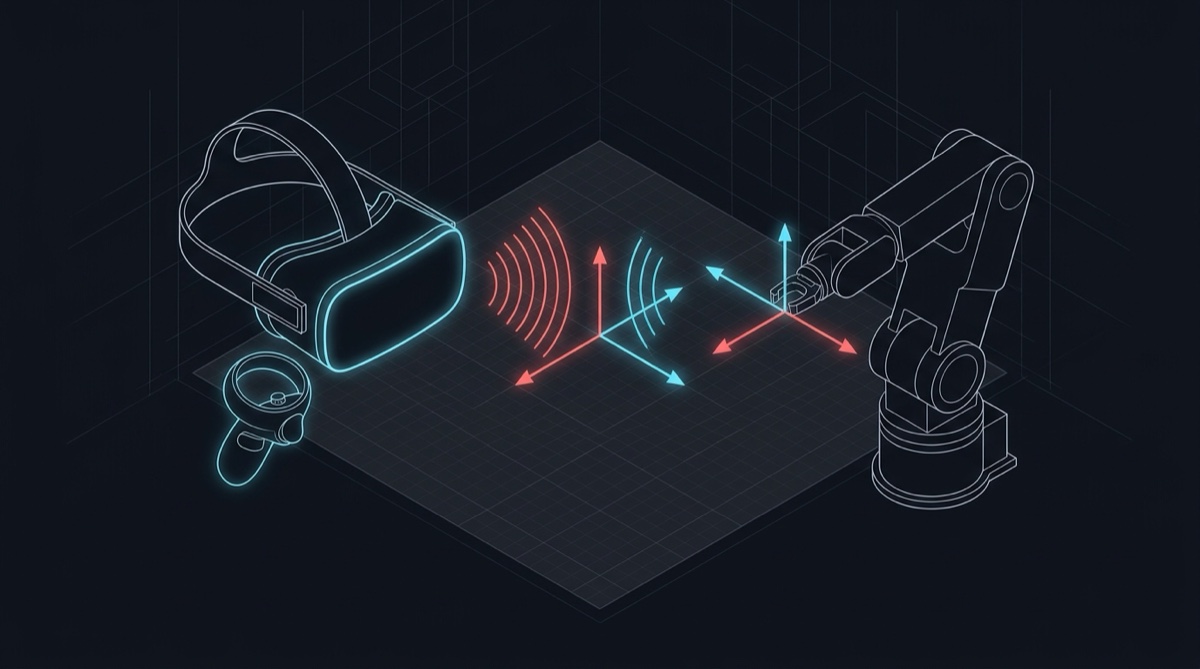
When I built a WebXR teleoperation stack for remote inspection on Android and Meta Quest, that friction showed up immediately: pure manual pose tracking gives the operator full authority, while pure autonomy is brittle in unstructured scenes. Intent-based shared autonomy sits right in the middle — continuously estimating what the operator is trying to do from VR motion and perception cues, and translating that belief into soft guiding constraints and hard safety barriers that help without wrestling control away from the human.
Step 1: Inferring Operator Intent From Noisy VR Input
Formally, suppose the workspace contains a set of candidate goals or task primitives $g \in \mathcal{G}$ (detected object grasp poses, inspection surfaces, or tool slots). As the operator streams VR controller poses or velocity commands $u_{0:t}$ along the robot trajectory $\xi_{0:t}$, the robot updates a Bayesian posterior over goals:
\[P(g \mid \xi_{0:t}, u_{0:t}) \;\propto\; P(g)\, \prod_{\tau=0}^{t} P(u_\tau \mid x_\tau, g)\]Following the foundational formalization of assistive teleoperation by Dragan & Srinivasa (RSS 2012), the observation likelihood \(P(u_\tau \mid x_\tau, g)\) is commonly modeled via maximum-entropy (Boltzmann) rationality: an operator aiming for goal $g$ is exponentially more likely to issue commands that reduce the cost-to-go \(Q_g(x_\tau, u_\tau)\):
\[P(u_\tau \mid x_\tau, g) \;\propto\; \exp\!\big(-\beta\, A_g(x_\tau, u_\tau)\big)\]where $A_g$ is the advantage (suboptimality) of command $u_\tau$ relative to the optimal motion toward $g$, and $\beta > 0$ reflects how noisy or precise the human interface is.
A classic pitfall here is predict-then-act: waiting until $\max_g P(g \mid \cdot)$ crosses a high threshold (say 0.9) before offering any help. By the time the robot is 90% sure which object you want, you have already done the hard alignment yourself. Shared Autonomy via Hindsight Optimization (Javdani, Srinivasa, & Bagnell, RSS 2015) avoids that trap by modeling shared autonomy as a POMDP over the unknown goal $g$ and minimizing expected cost-to-go across the entire belief distribution. Even when two goals are still ambiguous, the robot can assist along the shared corridor toward both — committing only as the operator’s motion disambiguates them.
Recent work has also removed the assumption that $\mathcal{G}$ must be hand-engineered in advance. Zero-shot vision-only shared autonomy (arXiv:2501.08389) uses end-effector perception to hypothesize candidate goals on the fly without a fixed task library, while VR-specific interfaces add head orientation and gaze cues that often disambiguate operator intent hundreds of milliseconds before hand motion does.
Step 2: Turning Intent Into Constraints Instead of Blind Blending
The simplest way to turn inferred intent into robot motion is linear policy blending (Dragan & Srinivasa, 2012):
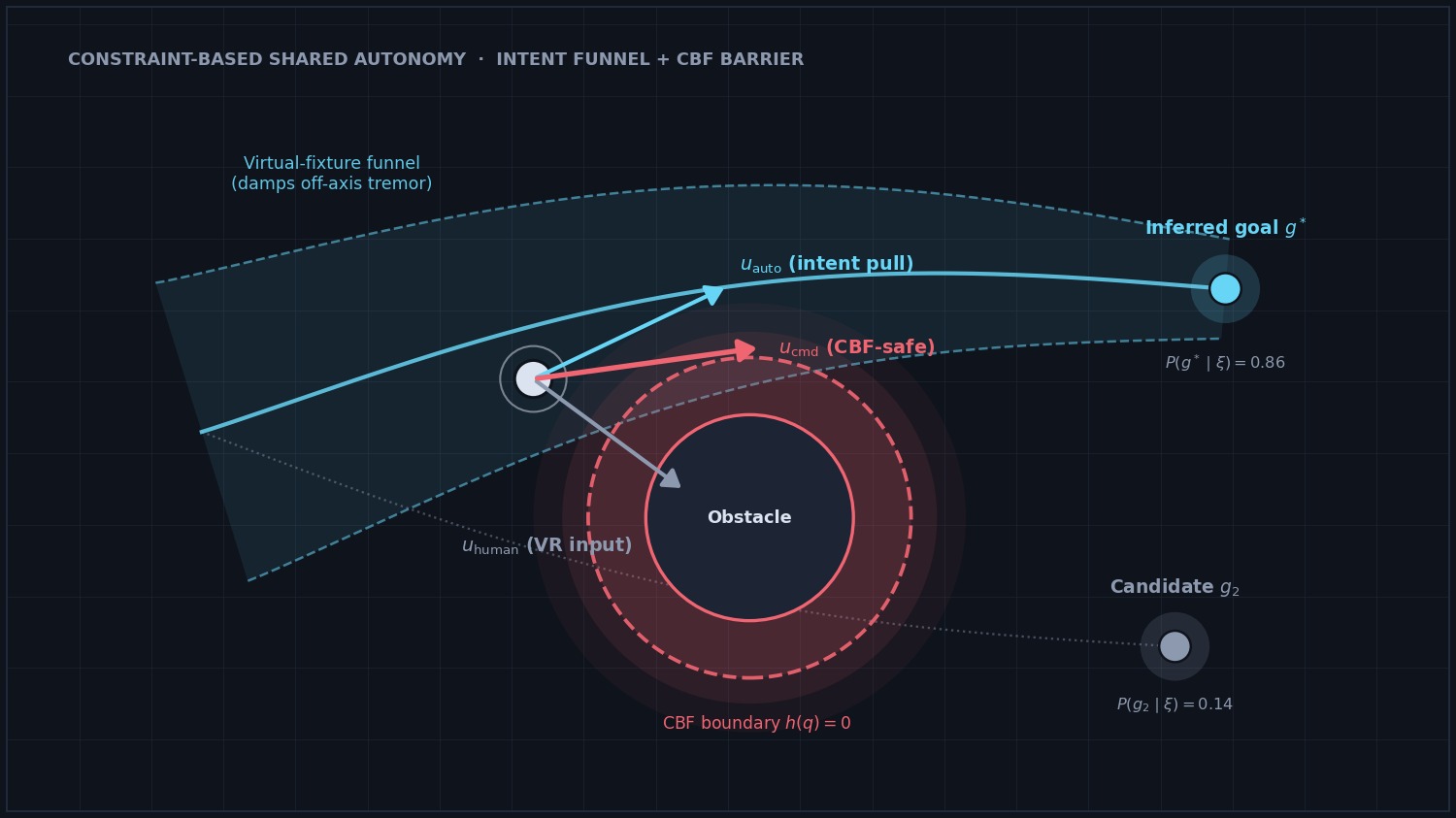
\[u_{\text{cmd}} \;=\; (1 - \alpha)\, u_{\text{human}} + \alpha\, u_{\text{auto}}\]where the arbitration weight $\alpha \in [0, 1]$ rises with intent confidence. Linear blending works well in open space, yet it has two notorious flaws in real manipulation:
- Averaging two safe actions can produce an unsafe one. If the human steers left around an obstacle and the autonomous policy steers right, their convex combination drives straight into the obstacle.
- Operators hate losing agency. When $\alpha$ ramps up aggressively on the wrong goal, the arm feels “sticky” or haunted, forcing the human to fight the controller.
A cleaner paradigm — especially well-suited to 6-DoF VR teleoperation — is constraint-based shared control, where intent shapes constraints inside a real-time optimization problem (QP or inverse kinematics solver) rather than simply overriding the human’s command.
In practice, intent-driven constraints fall into two complementary families:
Soft Constraints: Intent-Conditioned Virtual Fixtures
A virtual fixture restricts or reshapes motion selectively along task-relevant degrees of freedom while leaving other axes completely free. Once intent inference identifies a likely target (say, aligning an inspection camera normal to a part surface, or inserting a connector along axis $\hat{n}$), the controller decomposes the human’s VR twist $u_{\text{human}}$ into parallel and orthogonal components relative to the inferred task manifold:
- Guidance / damping orthogonal to the task axis: Lateral jitter and unwanted roll/pitch drift are smoothly attenuated, proportional to posterior confidence $P(g \mid \cdot)$.
- Full human authority along progress: The operator still controls when and how fast to advance or pull back.
Traditionally, virtual fixtures required exact CAD geometry. Recent work on Diffusion-based Virtual Fixtures (arXiv:2411.02169) removes that requirement by diffusing smooth guidance and forbidden-region constraints directly over partial, noisy point clouds captured from onboard depth sensors — allowing intent-aware surface-following and keep-out fixtures in unmodeled environments.
Hard Constraints: Control Barrier Functions at the IK Layer
Soft guidance cannot guarantee safety when blending human input and autonomous assistance in clutter. Control Barrier Functions (CBFs) solve this by enforcing forward invariance of a safe set \(\mathcal{S} = \{q : h(q) \ge 0\}\) through a linear inequality inside a velocity/IK quadratic program:
\[\min_{\dot{q}} \; \frac{1}{2}\,\big\|\, J(q)\,\dot{q} - u_{\text{blend}} \,\big\|_W^2 \quad\text{s.t.}\quad \nabla_q h_i(q)^\top \dot{q} \;\ge\; -\gamma\, h_i(q) \quad \forall i\]Grounded in the Control Barrier Function QP formulation (Ames et al., arXiv:1903.11199, ECC 2019), placing CBF constraints directly inside the velocity/IK layer of a shared-autonomy teleoperation stack guarantees safety after intent blending. Because safety is enforced at the joint-velocity level, the robot smoothly slides tangentially along obstacle boundaries, respects joint limits, and never executes an unsafe post-blend compromise — even if the human and the intent predictor momentarily disagree.
Why VR makes intent constraints feel natural. Unlike a 2D joystick, a VR headset gives you a visual feedback channel right in the operator’s field of view. Rendering the inferred target highlight, active fixture funnel, and safety boundary transparently in VR turns assistance from a mysterious invisible force into a legible tool the operator can trust — or deliberately override.
Giving the Operator Control Over Assistance
One underappreciated lesson from VR user studies is that the best arbitration curve varies from person to person — and from task to task. Experts often prefer light tremor damping and hard collision barriers; novices prefer stronger alignment funnels. Work on user-customizable shared control in VR (arXiv:2403.13177) exposes assistance gains and active constraints directly inside the headset UI so operators can tune how assertive the robot is without leaving the workspace.
VR shared autonomy also pays dividends for robot learning data collection: damping jitter and keeping the end-effector safely aligned near contact surfaces cuts operator fatigue and produces cleaner, more consistent demonstrations for downstream imitation learning.
Key Design Principles for Real Hardware
Building intent-driven VR teleoperation that operators actually enjoy using comes down to four rules:
- Always preserve an effortless override. If intent inference locks onto the wrong object, a decisive human pull away from the fixture should rapidly drop confidence $P(g \mid \cdot)$ and release the constraint — never trap the operator.
- Enforce safety below the blend. Put collision, workspace, and joint-limit CBFs inside the low-level servo/IK QP so no combination of human jitter and intent assistance can violate hardware limits.
- Make inferred intent visible in the headset. Showing a subtle ghost frame or fixture corridor in VR eliminates the “why is the robot pulling left?” confusion that ruins blind shared autonomy.
- Match assistance to latency. Over Wi-Fi or remote links, local robot-side impedance and fixture constraints stabilize contact far better than asking a human to close a 100 ms visual-motor loop by hand.
References
- A. D. Dragan and S. S. Srinivasa. Formalizing Assistive Teleoperation. Robotics: Science and Systems (RSS), 2012.
- S. Javdani, S. S. Srinivasa, and J. A. Bagnell. Shared Autonomy via Hindsight Optimization. Robotics: Science and Systems (RSS), 2015.
- A. D. Ames, S. Coogan, M. Egerstedt, G. Notomista, K. Sreenath, and P. Tabuada. Control Barrier Functions: Theory and Applications. European Control Conference (ECC), 2019. arXiv:1903.11199
- User-customizable Shared Control for Robot Teleoperation via Virtual Reality. IROS, 2024. arXiv:2403.13177
- Diffusion-based Virtual Fixtures. 2024. arXiv:2411.02169
- Toward Zero-Shot User Intent Recognition in Shared Autonomy. 2025. arXiv:2501.08389