Embodied Question Answering Under Uncertainty: When to Look, Remember, or Abstain
If you ask a vision-language model (VLM) whether a stove was left on in a photograph, the problem is purely perceptual: everything the model needs is already in the pixels. Ask a home robot the same question from the hallway, and the nature of the problem changes completely. The stove is occluded behind a wall. Moving into the kitchen costs time, battery, and collision risk. Worse, the question itself might be underspecified (“Is my mug clean?” when there are three mugs in the sink).
That shift — from passive visual question answering to Embodied Question Answering (EQA) — turns language grounding into an active decision-making problem under uncertainty. Since OpenEQA (Majumdar et al., CVPR 2024) reframed EQA around open-vocabulary real-world environments and foundation models, the bottleneck has steadily shifted away from can a VLM describe what is in front of it? toward a much harder robotics question: how should an embodied agent represent what it does not yet know, decide where to look next, and know when to stop — or refuse to answer?
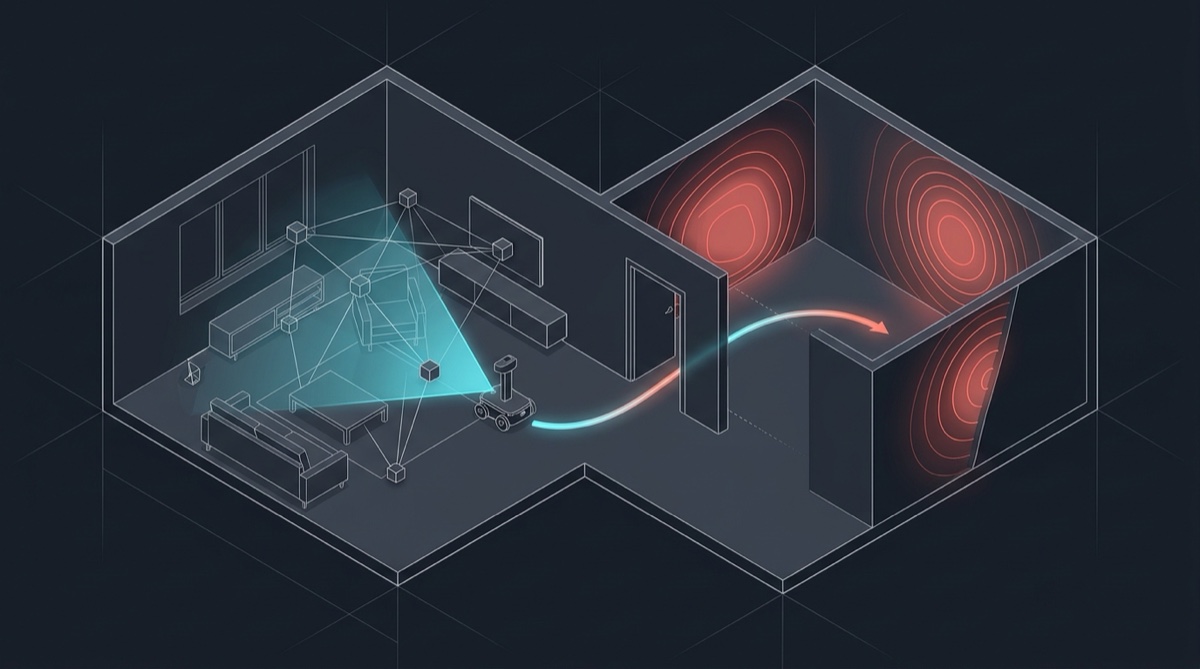
Two Kinds of Uncertainty — And Why VLMs Confuse Them
In classical active perception and robotic inspection, uncertainty has a clean physical meaning. If an agent maintains a belief state $b_t$ over the underlying 3D scene $s$ given observations $o_{1:t}$ and actions $a_{1:t-1}$, its uncertainty about the answer $y$ to a question $q$ splits along two axes:
- Epistemic (reducible) uncertainty: Information exists in the environment, but the robot has not observed it yet — an object is occluded, out of field of view, or in another room. Taking an informative viewpoint action $a$ reduces this uncertainty.
- Aleatoric or semantic (irreducible) uncertainty: Even with complete physical coverage of the scene, the query cannot be resolved unambiguously from observation alone — because the referent is ambiguous, depends on hidden user preferences, or rests on a false presupposition.
Off-the-shelf VLMs are notoriously bad at separating these two regimes. Trained to produce fluent answers to every prompt, they routinely hallucinate high-confidence responses from partial views (ignoring epistemic uncertainty) and guess rather than ask clarifying questions when a prompt is underspecified (ignoring semantic uncertainty). Making EQA work on real hardware means wrapping foundation models inside explicit spatial memory, calibrated stopping rules, and abstention mechanisms.
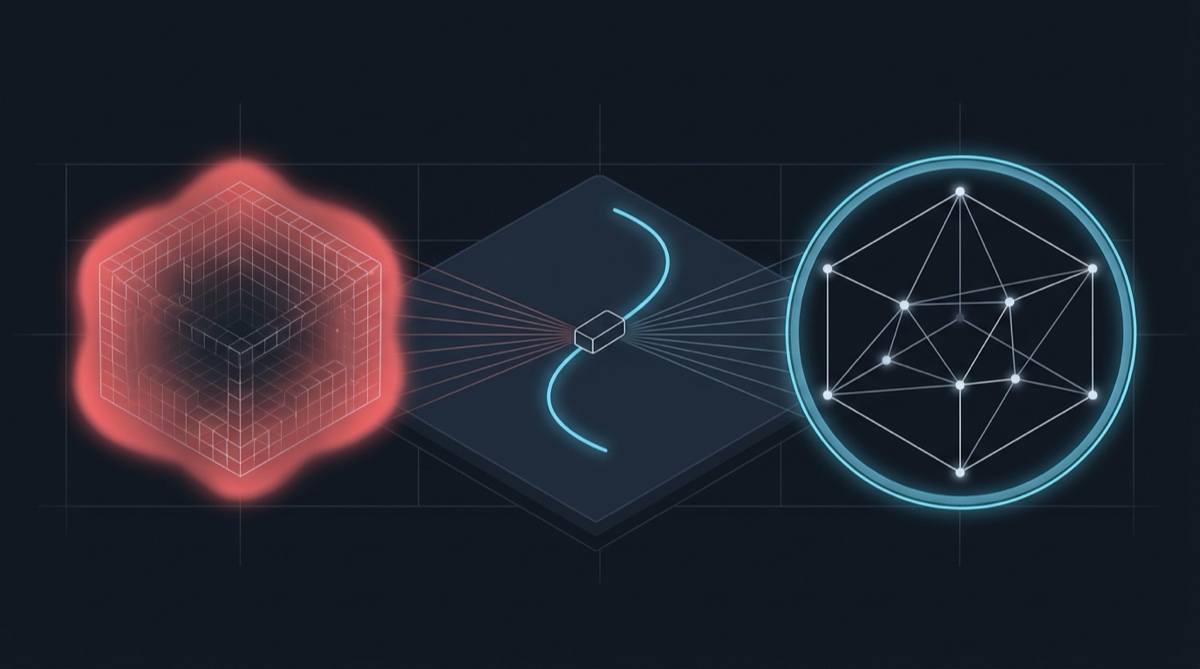
Grounding Uncertainty in Structured 3D Memory
A naive way to run an EQA agent is to append every RGB frame the robot captures into a VLM’s context window. In a multi-room home or industrial floor, that collapses quickly: context fills with redundant viewpoints, spatial relationships drift, and the model loses track of which frontiers remain unexplored.
Recent systems tackle this by separating metric-semantic spatial memory from language reasoning. In GraphEQA (Saxena et al., 2024), the agent builds a real-time 3D metric-semantic scene graph (3DSG) alongside task-relevant keyframes. Rather than reasoning over raw pixels alone, the VLM plans hierarchically over rooms, objects, and unexplored frontier nodes. Structuring memory this way does two things for uncertainty:
- Explicit coverage awareness: Unexplored frontiers live directly in the graph, so the planner knows which spatial hypotheses remain untested instead of relying on implicit VLM memory.
- Sample-efficient active exploration: Across HM-EQA, OpenEQA, and real-world home and office deployments, grounding VLM planning in a 3DSG yields higher answer accuracy in fewer navigation steps than unstructured baselines.
For long-horizon robots that operate across hours or days, memory introduces a second dimension of uncertainty: staleness. An object seen in the living room twenty minutes ago may have moved. Enter the Mind Palace (Ginting et al., CoRL 2025) formalizes this setting as Long-term Active EQA (LA-EQA), encoding episodic experiences into structured scene-graph world instances so the robot can explicitly trade off querying past memory against paying the physical cost to re-observe the present scene.
Calibrated Stopping: Explore Until Confident, Then Stop
Suppose a robot has a scene graph and a frontier planner. The most delicate decision in the entire loop is stopping: stop one step too early and you hallucinate; stop ten steps too late and your robot wanders an entire building to verify a coffee cup it already saw.
Formally, an active EQA agent faces an optimal-stopping trade-off between expected answer utility $U(b_t; q)$ and physical action cost $c(a)$:
\[\text{VoI}(a \mid b_t, q) \;=\; \mathbb{E}_{o_{t+1} \sim P(\cdot \mid b_t, a)}\!\Big[U\big(b_{t+1}; q\big)\Big] - U(b_t; q)\]The agent should keep exploring only while at least one candidate action delivers positive net value of information:
\[\max_{a \in \mathcal{A}_{\text{explore}}} \Big(\text{VoI}(a \mid b_t, q) - \lambda\, c(a)\Big) > 0\]Two complementary lines of recent work operationalize this idea without requiring an intractable exact POMDP solver:
- Conformal prediction for calibrated stopping. Explore-EQA (Ren et al., 2024) pairs VLM-guided semantic frontier exploration with conformal prediction over VLM answer confidences (I go deeper into the method in Conformal Prediction in Robotics). Instead of trusting raw softmax scores (which are famously miscalibrated), the agent maintains a calibrated prediction set \(\mathcal{C}_\alpha(o_{1:t}, q)\) calibrated on held-out trajectories to achieve a user-specified target accuracy $1 - \alpha$. The robot keeps exploring while the prediction set remains ambiguous (\(\lvert \mathcal{C}_\alpha \rvert > 1\)) and terminates as soon as visual evidence collapses the set to a single confident answer.
- Value-of-information (VoI) stopping over episodic memory. In Enter the Mind Palace, stopping is framed directly around whether additional exploration will meaningfully improve confidence relative to existing episodic memory — unifying memory recall and physical navigation under one decision rule.
Connection to active viewpoint planning. Strip away the language wrapper, and calibrated stopping in EQA is a semantic cousin of coverage viewpoint planning in robotic inspection: both ask which next sensor pose maximizes task-relevant information gain per unit of motion, and both fail badly when a pipeline acts on unverified observations instead of quantifying observation quality first.
Surfacing Implicit Assumptions — And Knowing When to Abstain
Even a perfectly calibrated stopping rule breaks down if the agent’s reasoning rests on hidden, unchecked assumptions or if the question itself cannot be answered. Two 2025–2026 results sharpen this picture considerably:
Turning Implicit Assumptions Into Uncertainty-Aware Plans
When an LLM generates a linear chain-of-thought plan in a partially observable room (“The scissors are probably in the desk drawer, so go check the study”), it commits implicitly to one world hypothesis. From Assumptions to Actions (Seo et al., ICLR 2026) proposes a Planner-Composer-Evaluator (PCE) framework that extracts those latent assumptions from LLM reasoning traces and compiles them into an explicit scenario decision tree. Branching over plausible hidden states — and scoring trajectories by scenario likelihood and goal-directed gain — lets an embodied agent choose actions that hedge across competing hypotheses instead of chasing a brittle single guess.
When the Right Answer Is “I Don’t Know”
What if the robot explores thoroughly and the question is still unanswerable? When Robots Should Say “I Don’t Know” (Wu et al., 2025) studies abstention directly. Analyzing 500 natural human queries, the authors find that 32.4% contain missing or underspecified context, falling into five recurring failure modes:
- Actionability limitation — verifying the answer requires physical interaction the robot cannot perform (e.g., checking inside a locked cabinet).
- Referential underspecification — multiple matching objects exist with no disambiguating cue.
- Preference dependence — the answer depends on subjective user preferences rather than scene state.
- Information unavailability — the needed evidence is absent from the environment altogether.
- False presupposition — the query assumes an object or state that does not exist in the scene.
On their resulting AbstainEQA benchmark (1,636 abstention cases paired with 1,636 answerable OpenEQA queries), the gap is stark: frontier VLMs reach only 42.79% abstention recall compared to 91.17% for humans, and naive scaling, chain-of-thought prompting, or fine-tuning yields only marginal gains (with fine-tuned models overfitting to textual shortcuts rather than grounded visual insufficiency).
Three Open Problems for Real-World Embodied Systems
Reading across these papers from a robotics systems perspective points to three concrete gaps worth working on next:
- Calibration under active distribution shift. Standard conformal prediction assumes exchangeability between calibration trajectories and test trajectories. An active robot deliberately steers its own observation distribution as it explores, creating feedback loops between the policy and the uncertainty estimator. Online and adaptive conformal methods tailored to active perception remain wide open.
- Separating “look further” from “ask the human.” Current systems largely treat exploration stopping (Explore-EQA, Mind Palace) and query abstention (AbstainEQA) as separate benchmarks. A deployed robot needs a single unified policy that chooses among three actions at every step: answer now, move to gather more evidence, or abstain and ask a targeted clarification question.
- Bridging semantic reasoning with continuous geometry. Most EQA planners still operate over coarse frontier waypoints or discrete viewpoint hops. Tightly coupling high-level VLM uncertainty with continuous, kinematically smooth sensor-planning trajectories — where visibility, occlusion, and sensor noise are modeled directly in 3D — is where foundation-model reasoning starts feeling like a real robot rather than a slideshow.
References
- A. Majumdar, A. Ajay, X. Zhang, P. Putta, S. Yenamandra, M. Henaff, S. Silwal, P. Mcvay, O. Maksymets, S. Arnaud, K. Yadav, Q. Li, B. Newman, M. Sharma, V. Berges, S. Zhang, P. Agrawal, Y. Bisk, D. Batra, M. Kalakrishnan, F. Meier, C. Paxton, A. Sax, and A. Rajeswaran. OpenEQA: Embodied Question Answering in the Era of Foundation Models. CVPR 2024. open-eqa.github.io
- A. Z. Ren, J. Clark, A. Dixit, M. Itkina, A. Majumdar, and D. Sadigh. Explore until Confident: Efficient Exploration for Embodied Question Answering. 2024. arXiv:2403.15941
- S. Saxena, B. Buchanan, C. Paxton, P. Liu, B. Chen, N. Vaskevicius, L. Palmieri, J. Francis, and O. Kroemer. GraphEQA: Using 3D Semantic Scene Graphs for Real-time Embodied Question Answering. 2024. arXiv:2412.14480
- M. F. Ginting, D.-K. Kim, X. Meng, A. Reinke, B. J. Krishna, N. Kayhani, O. Peltzer, D. D. Fan, A. Shaban, S.-K. Kim, M. J. Kochenderfer, A. Agha, and S. Omidshafiei. Enter the Mind Palace: Reasoning and Planning for Long-term Active Embodied Question Answering. CoRL 2025. arXiv:2507.12846
- T. Wu, C. Zhou, G. Zhao, H. Cao, Y. Pu, and J. Yang. When Robots Should Say “I Don’t Know”: Benchmarking Abstention in Embodied Question Answering. 2025. arXiv:2512.04597
- S. Seo, S. Lim, S. Noh, H. Kim, and H. Kang. From Assumptions to Actions: Turning LLM Reasoning into Uncertainty-Aware Planning for Embodied Agents. ICLR 2026. arXiv:2602.04326