Conformal Prediction in Robotics: From Distribution-Free Guarantees to Closed-Loop Safety
Deep neural networks power almost every modern robotics stack — trajectory predictors, vision-language planners, and diffusion-based visuomotor policies. What they do not give you out of the box is trustworthy uncertainty. Softmax probabilities are routinely overconfident on out-of-distribution inputs, Bayesian ensembles are expensive to run at 50 Hz, and Gaussian uncertainty assumptions break down the moment a scene becomes multimodal or contact-rich.
Conformal prediction has quietly become one of the most practical answers to this problem in robotics. Instead of modifying how a model is trained or assuming Gaussian noise, conformal prediction wraps any black-box predictor with a lightweight calibration step that delivers finite-sample, distribution-free coverage guarantees (Angelopoulos & Bates, arXiv:2107.07511). The catch is that robotics violates conformal prediction’s cleanest statistical assumption almost immediately — which is where the most interesting recent work lives.

The Core Theory: Split Conformal Prediction in Four Lines
Suppose you have a pretrained model $\hat{f}$ — anything from a pedestrian trajectory forecaster to a VLM scoring candidate actions — and a held-out calibration dataset \(\mathcal{D}_{\text{cal}} = \{(X_i, Y_i)\}_{i=1}^{n}\) drawn from the same distribution as a new test point \((X_{\text{test}}, Y_{\text{test}})\).
The entire split conformal recipe reduces to three steps:
- Define a nonconformity score $s(x, y) \in \mathbb{R}$ that measures how poorly $\hat{f}(x)$ agrees with $y$. For regression or trajectory prediction, this is often the residual norm \(s(x, y) = \|y - \hat{f}(x)\|\). For discrete action or language choices, it is typically $s(x, y) = 1 - \hat{p}(y \mid x)$.
Compute the calibrated quantile $\hat{q}$ across the $n$ calibration scores \(S_i = s(X_i, Y_i)\):
\[\hat{q} \;=\; \text{Quantile}\!\left(\{S_1, \dots, S_n\},\; \frac{\lceil (n + 1)(1 - \alpha) \rceil}{n}\right)\]Construct the prediction set at test time:
\[\mathcal{C}(X_{\text{test}}) \;=\; \big\{\, y \in \mathcal{Y} \;:\; s(X_{\text{test}}, y) \le \hat{q} \,\big\}\]
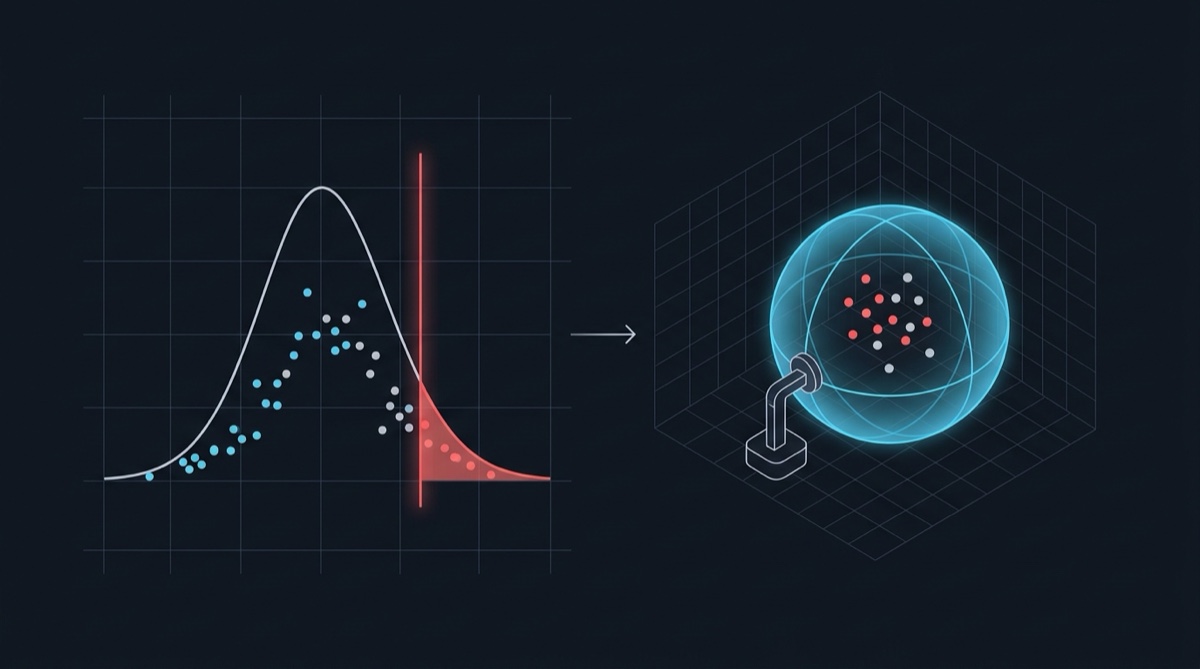
Under a single assumption — exchangeability of \((X_1, Y_1), \dots, (X_n, Y_n), (X_{\text{test}}, Y_{\text{test}})\) (slightly weaker than i.i.d.) — the rank of $S_{\text{test}}$ among the $n + 1$ scores is uniform, which yields an exact finite-sample guarantee regardless of the underlying distribution or model quality:
\[1 - \alpha \;\le\; \mathbb{P}\!\big(Y_{\text{test}} \in \mathcal{C}(X_{\text{test}})\big) \;\le\; 1 - \alpha + \frac{1}{n + 1}\]Notice what this guarantee does and does not say. It holds for any sample size $n$ and any black-box architecture — even a badly miscalibrated one. A better model simply produces smaller, sharper prediction sets $\mathcal{C}(X_{\text{test}})$ at the same coverage level $1 - \alpha$.
Where Conformal Prediction Fits in Robotics
Over the past three years, conformal prediction has moved rapidly from statistical theory into three distinct layers of the robotics stack.
1. Safe Motion Planning Around Dynamic Agents
When a mobile robot or autonomous vehicle plans around humans, learned trajectory predictors (LSTMs, transformers, diffusion forecasters) output point predictions with no calibrated error bars. In Safe Planning in Dynamic Environments using Conformal Prediction, Lindemann et al. (arXiv:2210.10254, IEEE RA-L 2023) calibrate multi-step prediction errors across offline trajectories of dynamic agents, turning each forecast step into a guaranteed radius $R_\tau$. Feeding those conformal regions directly as collision-avoidance constraints inside a Model Predictive Controller (MPC) gives probabilistic safety guarantees over the entire planning horizon without knowing the true distribution of human motion.
2. Uncertainty Alignment for LLM & VLM Planners
Foundation models fail differently than trajectory forecasters: given an ambiguous natural-language command (“Bring me the bowl” when two bowls sit on the counter), an LLM planner will happily pick one with high verbal confidence. KnowNo (Ren et al., arXiv:2307.01928, CoRL 2023) applies conformal prediction to next-token action probabilities over candidate plans. If the calibrated prediction set $\mathcal{C}(x)$ contains only one option, the robot executes autonomously; if \(|\mathcal{C}(x)| > 1\), the robot asks the human for clarification across the options in the set. That single mechanism turns a user-chosen risk budget $\alpha$ into a provable trade-off between task success rate and human intervention rate.
The same machinery extends directly to active perception. In Explore-EQA (see also my follow-up note on Embodied QA under uncertainty), conformal prediction calibrates VLM answer sets so an exploring robot stops moving only once visual evidence collapses the prediction set to a confident answer.
3. Runtime Failure Detection for Generative Robot Policies
Diffusion policies and flow-matching visuomotor policies have raised the bar for dexterous manipulation, yet they still fail silently when observations drift off the training manifold. FIPER (Römer et al., arXiv:2510.09459, NeurIPS 2025) tackles runtime failure prediction without requiring any failure trajectories during calibration. It combines out-of-distribution observation scoring (via Random Network Distillation in embedding space) with an action-chunk entropy (ACE) score capturing multimodal uncertainty across sampled action chunks, then uses conformal prediction over a small set of successful rollouts to set statistically calibrated alarm thresholds. Because only nominal rollouts are needed, the method sidesteps the impractical problem of collecting representative failures on physical hardware.
The Catch: Closed-Loop Robots Break Exchangeability
If split conformal prediction is this clean, why isn’t every robot running it already? Because robots act in closed loops, and closed-loop interaction breaks exchangeability in two immediate ways:
- Temporal correlation and distribution shift: Consecutive observations along a trajectory are correlated, and moving into a new room, lighting condition, or crowd shifts the test distribution away from the offline calibration set.
- Policy-induced shift: In active perception or interactive manipulation, the robot’s own actions change the future state distribution — meaning the calibration trajectories collected under one behavior no longer match the trajectories induced once a safety filter or active planner takes over.
Adaptive Conformal Prediction (ACP) directly addresses online distribution shift. In Adaptive Conformal Prediction for Motion Planning among Dynamic Agents, Dixit et al. (arXiv:2212.00278) update the target miscoverage parameter $\alpha_t$ online after observing whether the previous prediction set covered the realized state:
\[\alpha_{t+1} \;=\; \alpha_t + \gamma\,\big(\alpha - \mathbf{1}\{Y_t \notin \mathcal{C}_t(X_t)\}\big)\]When the environment suddenly gets harder and misses occur, $\alpha_t$ shrinks and the safety envelopes automatically inflate; when forecasts stabilize, the envelopes tighten back down so the controller does not freeze in place. Over long horizons, online updates recover asymptotic average coverage even under non-exchangeable, time-varying dynamics.
Engineering takeaway. Conformal prediction does not fix a weak model — if your nonconformity score is poorly designed, your valid prediction set will simply be huge and conservative. In robotics, half the craft is designing informative, task-aligned nonconformity scores (action-chunk entropy, reprojection error, semantic margins) so the resulting guarantees stay tight enough for a real controller to act on.
What Remains Open
Three practical tensions stand out when deploying conformal wrappers on physical robots:
- Marginal vs. conditional coverage. Standard conformal guarantees hold on average over the test distribution, not conditionally on every rare edge case — which matters in safety-critical manipulation where rare contact modes cause most failures. Mondrian / group-conditional variants help, at the cost of more calibration data per stratum.
- Choosing the right score space. For high-dimensional continuous action chunks (e.g., 16-step 7-DoF trajectories), naive Euclidean residuals in joint space produce overly conservative hyperspheres. Structured, task-space, or learned nonconformity scores are key to keeping sets actionable.
- Closing the loop between coverage and conservatism. Guaranteeing safety is trivial if the robot refuses to move. Coupling adaptive conformal sets tightly with smooth recovery behaviors — slowing down, asking for clarification, or taking an information-gathering glance — is where statistical rigor turns into genuinely capable embodied behavior.
References
- A. N. Angelopoulos and S. Bates. A Gentle Introduction to Conformal Prediction and Distribution-Free Uncertainty Quantification. arXiv:2107.07511
- L. Lindemann, M. Cleaveland, G. Shim, and G. J. Pappas. Safe Planning in Dynamic Environments using Conformal Prediction. IEEE RA-L, 2023. arXiv:2210.10254
- A. Dixit, L. Lindemann, S. X. Wei, M. Cleaveland, G. J. Pappas, and J. W. Burdick. Adaptive Conformal Prediction for Motion Planning among Dynamic Agents. L4DC, 2023. arXiv:2212.00278
- A. Z. Ren, A. Dixit, A. Bodrova, S. Singh, S. Tu, N. Brown, P. Xu, L. Takayama, F. Xia, J. Varley, Z. Xu, D. Sadigh, A. Zeng, and A. Majumdar. Robots That Ask For Help: Uncertainty Alignment for Large Language Model Planners (KnowNo). CoRL, 2023. arXiv:2307.01928
- A. Z. Ren, J. Clark, A. Dixit, M. Itkina, A. Majumdar, and D. Sadigh. Explore until Confident: Efficient Exploration for Embodied Question Answering. 2024. arXiv:2403.15941
- R. Römer, A. Kobras, L. Worbis, and A. P. Schoellig. FIPER: Failure Prediction at Runtime for Generative Robot Policies. NeurIPS, 2025. arXiv:2510.09459