Pose Estimation: Understanding what is where?
Pose estimation means recovering an object's position and orientation in a scene: its 6-DoF pose, three translations and three rotations, relative to the sensor. A robot needs it before it can interact with anything, whether that is grasping, navigating or working alongside people.
Approaches split broadly into model-based methods, which match observations against a 3D model of the object, and data-driven methods, which learn pose directly from data. My work here is model-based: estimating a part's pose from a point cloud, using the same structured light sensor that does the scanning, so no extra hardware is needed.
Why the Metrology Pipeline Needs It
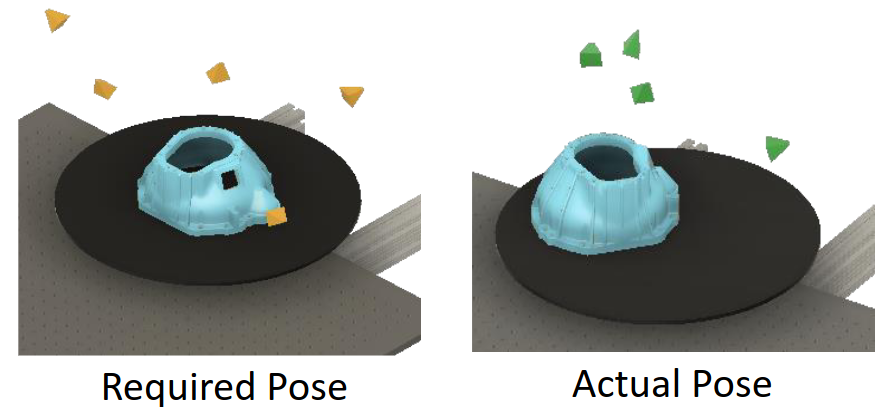
In the robotic metrology cell, the viewpoints that guarantee full surface coverage are computed for a nominal part pose. If the part sits even slightly differently on the turntable, those viewpoints no longer cover the surface. Pose estimation closes that gap: estimate where the part actually is, then correct the viewpoints to match.
Global Registration
Fast Point Feature Histograms (FPFH) describe the local geometry around each point in a cloud. They extend Point Feature Histograms (PFH), which build a histogram of geometric relationships between a point and its neighbors; FPFH makes this much cheaper to compute, using a fast and robust local reference frame to align point pairs before building the histogram.
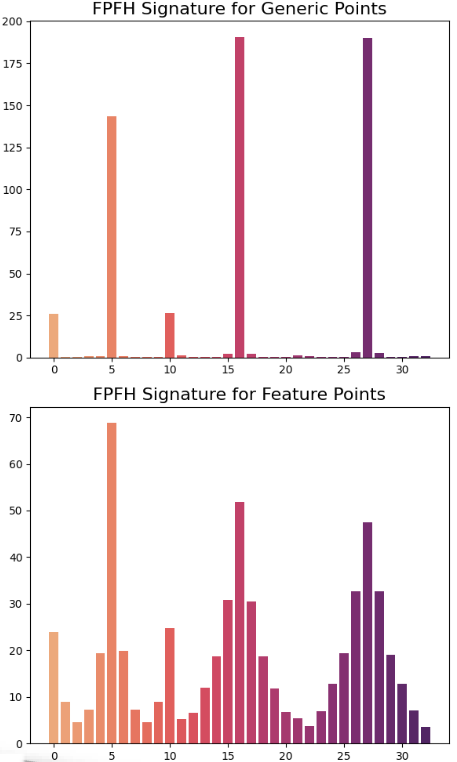
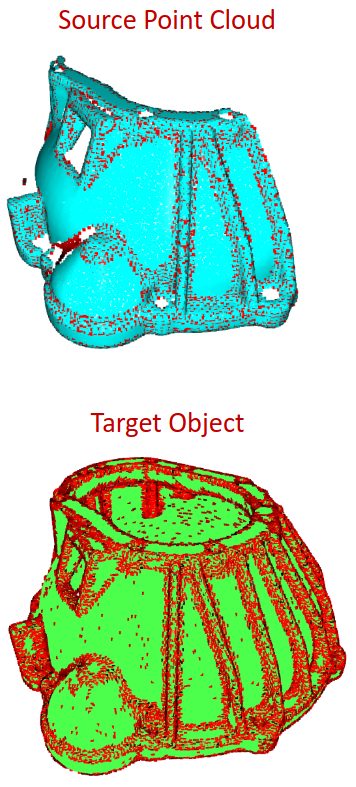
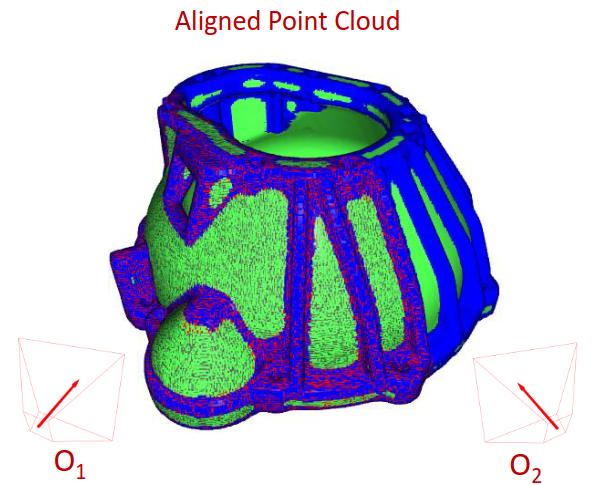
I extract FPFH features from the scene cloud and match them against the object model's features to get a rough pose. This global registration runs on downsampled clouds, with Random Sample Consensus (RANSAC) fitting the transform to the matched features.
Fine Registration
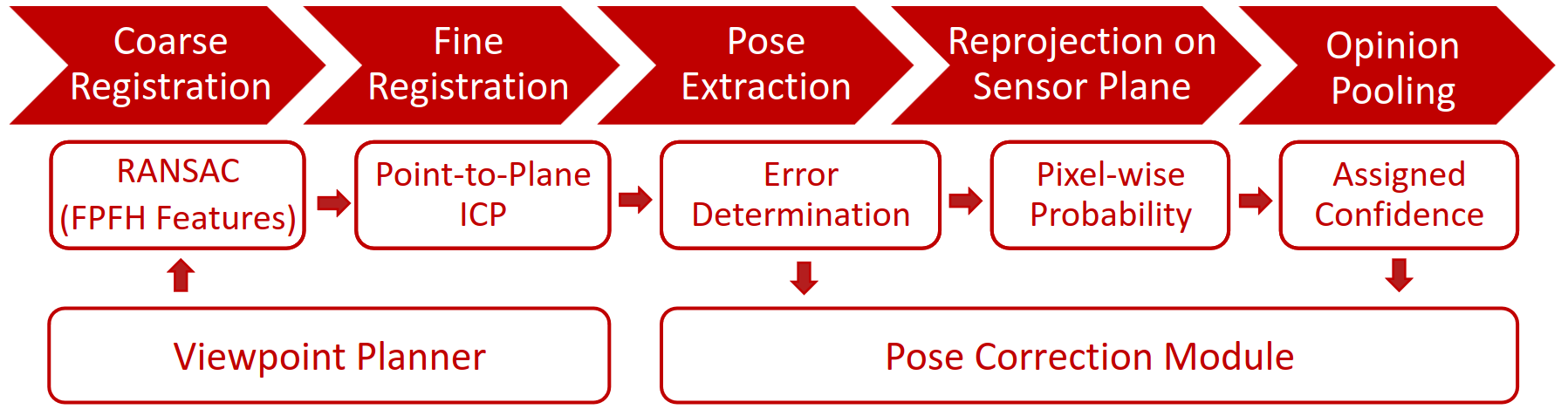
The global estimate warm-starts point-to-plane ICP, which refines the pose by iteratively minimizing the distance between corresponding points on the scan and the model, with correspondences seeded from the FPFH matches. The transform ICP converges to is the object's pose.
Implementation
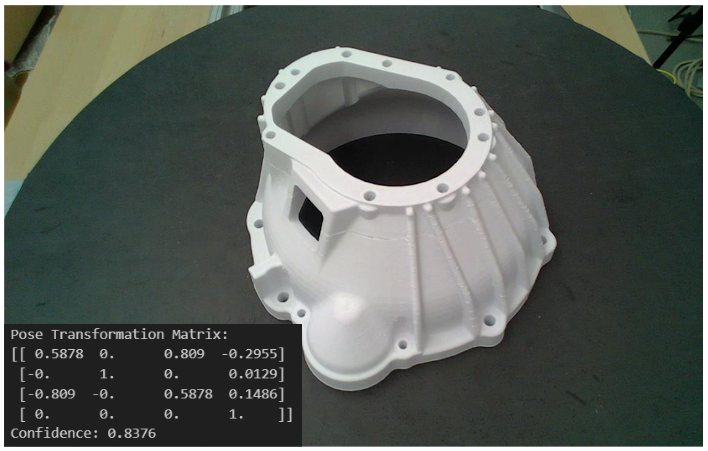
The pipeline is implemented in Python with Open3D and our in-house ROS bindings for point cloud data. Capturing the rough scan takes 3.3 seconds on average, the pose estimation engine returns in under 4 seconds, and the full pipeline produces a pose estimate in under 8 seconds. It is available as a ROS node for ROS-based systems. The final stage scores each estimate with the registration quality metric.
Next, I plan to move feature extraction and alignment to the Point Cloud Library (PCL). Feature extraction is well suited to the GPU. The goal is a pose estimate rate of 1 Hz or better, enough for live object tracking during scanning.