Pose Estimation through Stable Diffusion
Pose estimation recovers where an object is and how it is oriented from an image. It works well until the object is partly hidden or sitting in clutter. At that point the local features classical extractors depend on are either occluded or ambiguous, and the depth cues they encode go with them.
Diffusion models learn representations that carry a great deal of structure about objects and scenes, as a side effect of learning to generate them. This project, for CMU 16-825 (Learning for 3D Vision), asked whether those internal features survive occlusion better than purpose-built descriptors.
Approach
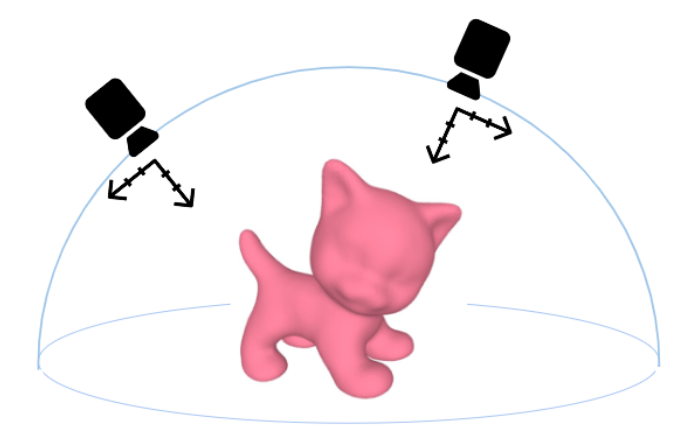
Training and evaluation used LINEMOD, a benchmark chosen for exactly the conditions that break feature matching: occluded, texture-less objects in cluttered scenes. Template views of each object are rendered from viewpoints sampled around it, giving supervision across poses and viewing conditions the dataset itself underrepresents.
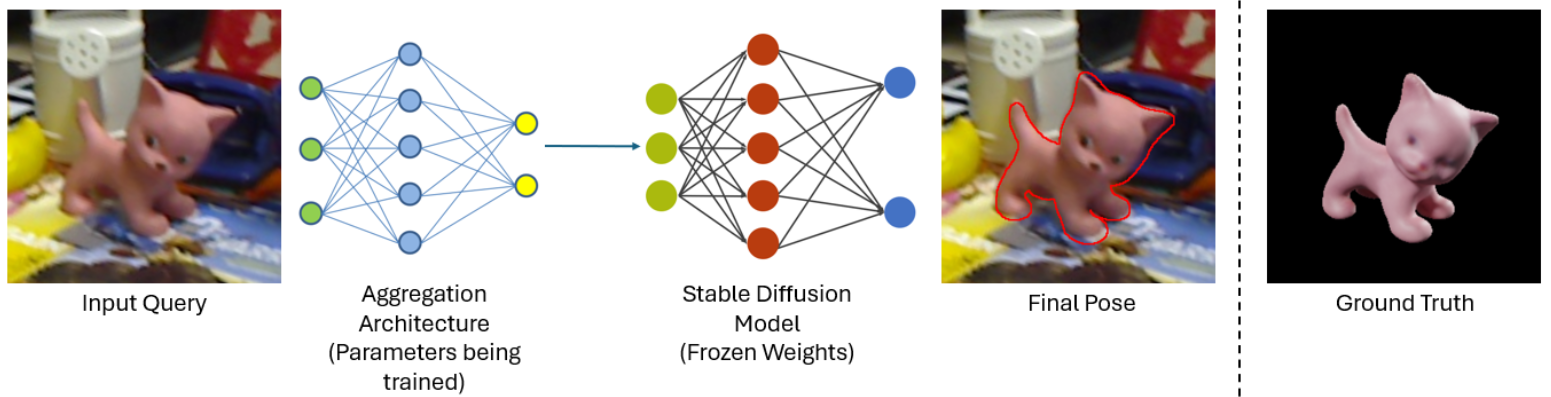
The model is trained with an InfoNCE contrastive loss. The choice matters here: pose estimation lives or dies on separating features from nearby viewpoints, which look almost identical, and a contrastive objective pushes exactly those near-neighbors apart in the embedding.
Results
Against traditional feature extraction, the diffusion-based approach improves both accuracy and error rates, on seen and unseen objects alike. It holds up in clear views and under moderate occlusion.
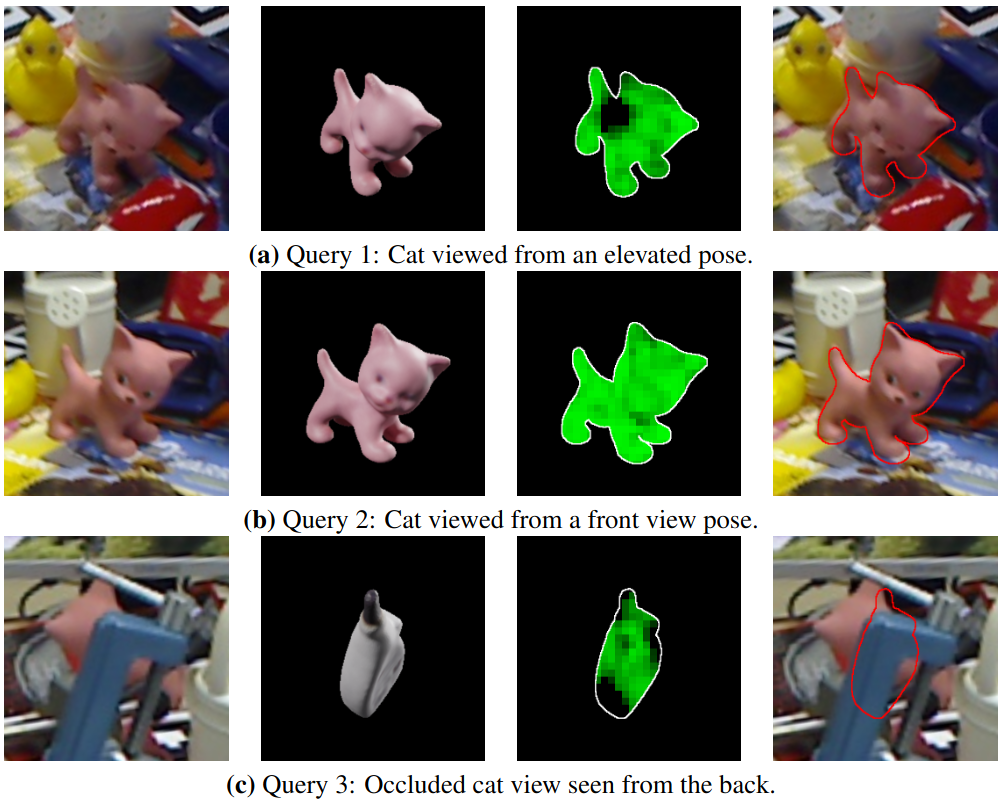
Heavy occlusion still breaks it, and it breaks in an informative way.
Failure mode. Under heavy occlusion the model misassigns the object class first, then produces a pose that is wrong because it is answering the wrong question. The recognition step has to degrade gracefully under occlusion before the pose estimate on top of it can.